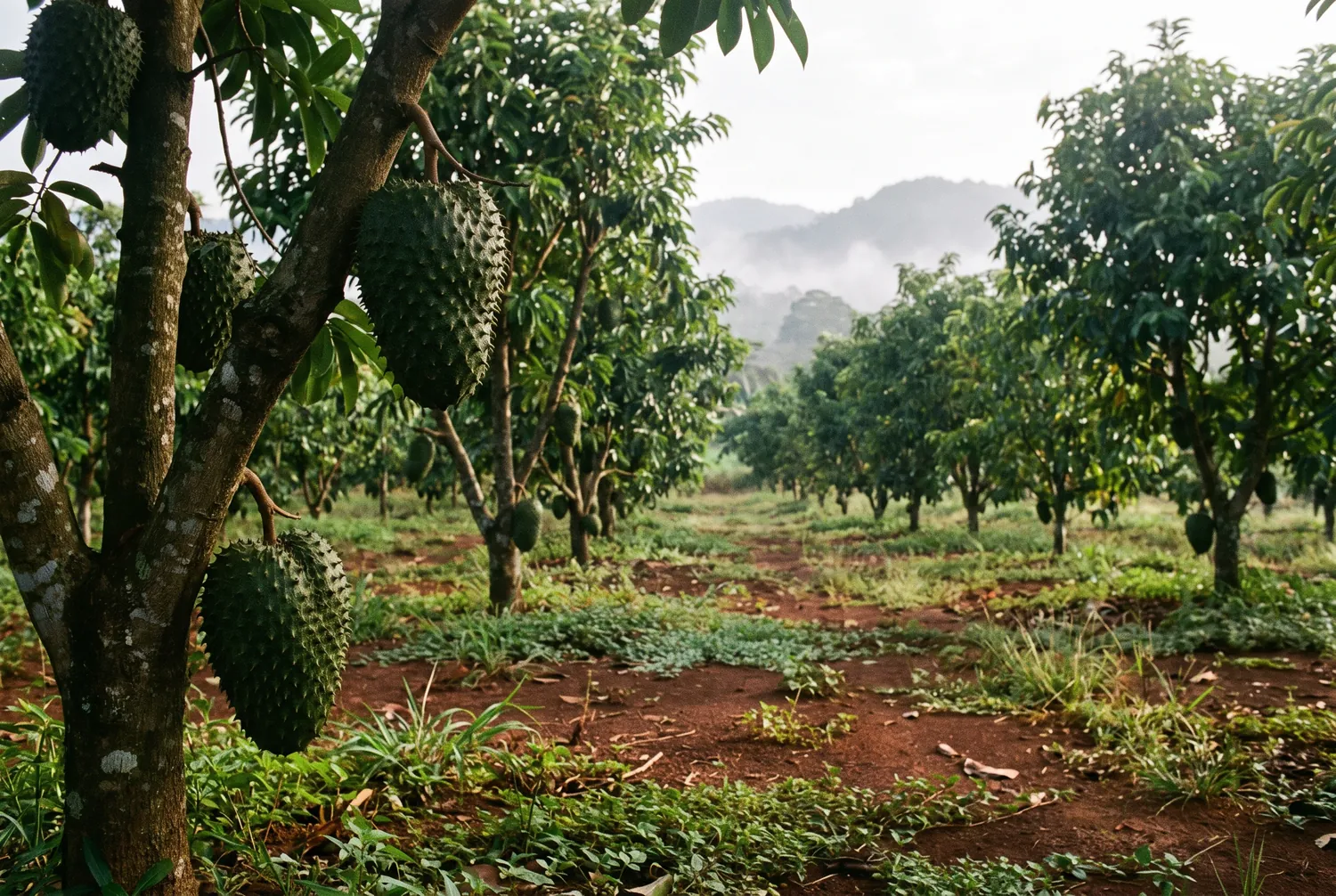
The most misreported fruit on the internet, explained properly.
Real nutrition, genuinely unusual chemistry, and a body of research far more interesting — and far more limited — than the headlines suggest.
- Binomial
- Annona muricata
- Family
- Annonaceae
- Native to
- Tropical Americas
- Tree height
- 4–10 m
- Fruit weight
- 1–4 kg
- Ripe shelf life
- 2–3 days
What people get wrong, in figures

Tap a number to read what each part is.
What soursop actually is
The fruit of Annona muricata, a small evergreen native to the tropical Americas and now grown across the Caribbean, Latin America, West Africa and Southeast Asia. It is the largest fruit in its genus: a heart-shaped, dark-green syncarp covered in soft, curved spines — which bend, and are the quickest way to tell it from a durian.
Inside is a creamy white pulp tasting of strawberry and pineapple over a custard body. The seeds are never eaten. Separately, its leaves are brewed as a caffeine-free tea — a different product from the fruit, and the source of most of the confusion about it.
Four ways into the subject
The Tree
An evergreen that flowers straight out of its own trunk and needs beetles — or a paintbrush — to set fruit.
Botany & cultivation → Part twoThe Fruit
Anatomy, flavor, how to tell when it is ripe, and the full nutrition panel per 100 g and per cup.
Anatomy & nutrition → Part threeHealth Benefits
Every claimed benefit, sorted by the strength of the evidence behind it — including the ones that fail.
Graded claims → Part fourResearch & Science
Acetogenins, the studies that exist, the studies that do not, and how to read a soursop paper.
The literature →Every claim on this site carries a tier
Most soursop content online flattens a cell-culture experiment and a randomized human trial into the same sentence. We label which is which, on every single claim, so you can weigh it yourself.
Tested in people, with a control group. The strongest evidence available for this fruit — and the rarest.
Measured in rodents, usually at doses far above normal eating. Suggestive, not transferable.
Cells or microbes in a dish, exposed to concentrated extract. Tells you about chemistry, not about people.
Documented use across the Caribbean, Latin America, West Africa and Southeast Asia. History, not proof.
Widely repeated online and contradicted, or simply unsupported, by the evidence. We say so plainly.